

Your eyes feel dry and tired by mid-afternoon, and you have not looked away from the screen since lunch. The 20-20-20 rule is the simplest advice eye doctors give for this. It takes twenty seconds. The hard part is remembering to do it.
This guide explains what the rule is, what it can and cannot do, and how to make it a habit that lasts longer than two days.
What is the 20-20-20 rule?
Every 20 minutes, look at something at least 20 feet away (about 6 metres) for at least 20 seconds. That is the whole rule. The American Academy of Ophthalmology and the American Optometric Association both recommend it for people who use screens for long periods.
Why screens tire your eyes
The main reason is simple: we blink much less when looking at a screen, and that leaves eyes dry and strained. Holding your focus at one short distance for a long time adds to it. Glare, a badly placed monitor and small text can make things worse.
The reassuring part is that the American Academy of Ophthalmology says eye strain does not cause lasting damage to your eyes. It is uncomfortable, and it is usually preventable.
Does the 20-20-20 rule actually work?
To be honest about the evidence: this is widely given expert advice, and it costs nothing to try. We did not find strong trial evidence proving that the rule alone reduces symptoms, and studies on it are still running. Think of it as a low-risk habit, not a cure.
This article is general information, not medical advice. If you have ongoing pain, blurred vision or headaches, see an eye doctor. You may simply need the right glasses.
Why most people give up on the 20-20-20 rule
The rule is easy. The reminder is the problem. When you are concentrating, you do not notice twenty minutes passing. A phone alarm is annoying and easy to silence. So the habit fades within a few days.
What helps is taking the decision out of your hands:
- Use a timer that interrupts your screen, not one you can ignore with one tap.
- Pick a real target. A window with a view works best. If you are in a small room, the far wall is better than nothing.
- Blink on purpose during the break. Close your eyes gently for a few seconds too.
- Allow for real life. If you are on a call, delay the break by a few minutes rather than skipping the habit altogether.
- Track your streak. Seeing a number go up keeps many people going.
Other simple ways to reduce eye strain
- Sit about an arm’s length from your screen, with the top of it at or just below eye level.
- Reduce glare from windows and overhead lights.
- Match screen brightness to the room, and increase the text size.
- Consider lubricating eye drops if your eyes feel dry, and ask a pharmacist or doctor which ones suit you.
You also do not need blue-light glasses for this: the American Academy of Ophthalmology does not recommend special blue-light eyewear for computer use.
A longer break matters too
Twenty seconds rests your eyes, but it does not rest the rest of you. Many people pair the 20-20-20 rule with a longer stand-up break every hour or so. We compare the popular rhythms in Pomodoro, 52/17 or 90/20.
How to automate the 20-20-20 rule with Take Rest
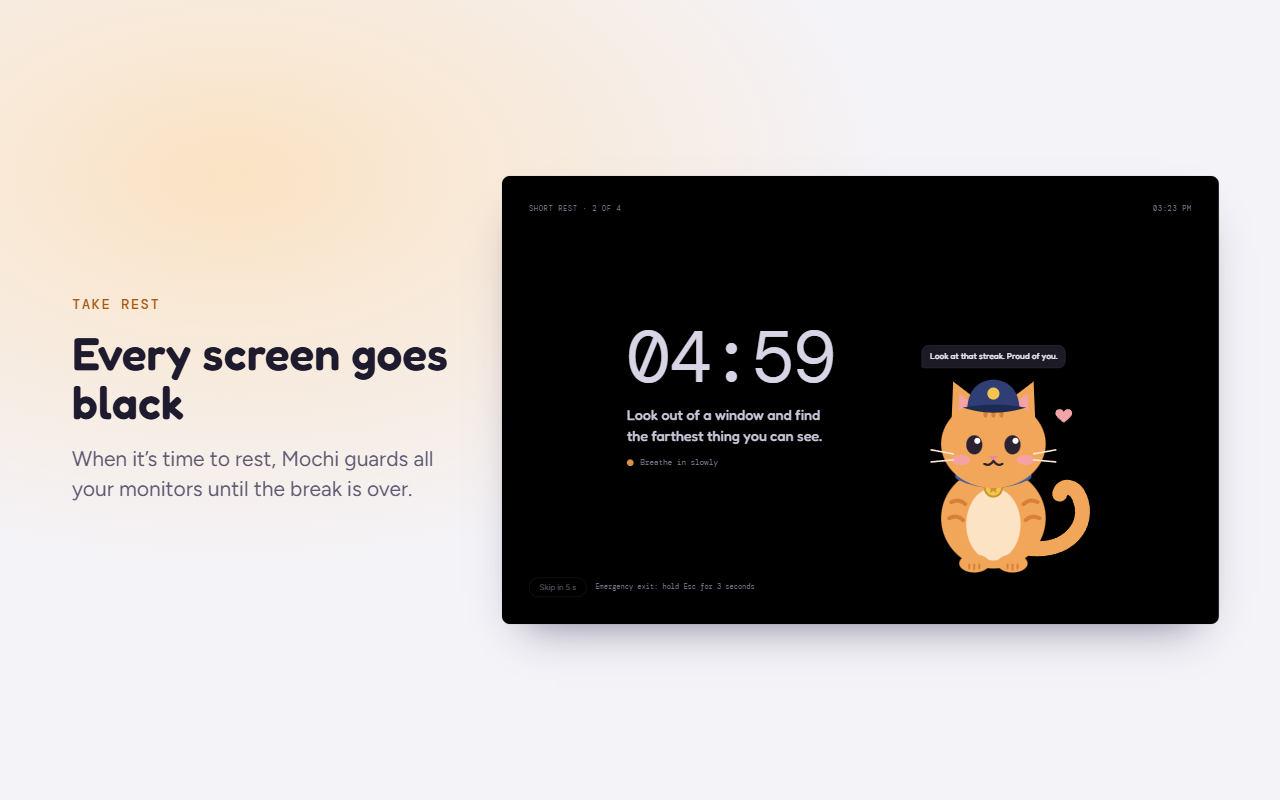
We built Take Rest, a Chrome extension, because reminders were so easy to ignore. Pick the 20-20-20 preset, and when the time is up every monitor turns black, with a countdown and a cat called Mochi sitting on your screen until the rest is over.
- Choose how firm it is: Gentle lets you skip any time, Balanced lets you skip after 10 seconds, and Strict has no skipping. Holding Esc for 3 seconds always gets you out in an emergency.
- Fair to real life: you get a heads-up with a snooze button before each rest, and time away from the computer counts as a rest.
- See your habits: today’s screen time, rests taken, your longest stretch and your streak.
- Private: your statistics stay on your computer.
You can also set your own times or use other rhythms such as Pomodoro 25/5. Add Take Rest from the Chrome Web Store.
The bottom line
The 20-20-20 rule is simple: every 20 minutes, look 20 feet away for 20 seconds, and blink. It will not fix everything, but it is free and takes almost no time. Make it automatic and you will actually keep doing it.
Frequently asked questions
What does the 20-20-20 rule mean?
Every 20 minutes of screen time, look at something at least 20 feet away, about 6 metres, for at least 20 seconds. It gives your eyes a short break from close focus.
What if I cannot see 20 feet away?
Use the farthest thing you can see, such as a window or the far wall of the room. The point is to shift your focus away from the screen and to blink.
Can eye strain cause permanent damage?
The American Academy of Ophthalmology says eye strain does not cause lasting damage. It can still be uncomfortable, so see an eye doctor if symptoms continue.
Do I need blue-light glasses?
The American Academy of Ophthalmology does not recommend special blue-light eyewear for computer use. Regular breaks and blinking are the usual advice.