


You sit down at nine, look up, and it is two o’clock. Your back hurts, your eyes are dry, and you have not moved. You know you should take breaks, but how often? The Pomodoro technique says every 25 minutes. A famous study says 52. Others swear by 90.
Here is what each rhythm really is, how strong the evidence is, and how to choose one that suits your kind of work.
The three rhythms at a glance
| Rhythm | Work | Break | Best for |
|---|---|---|---|
| Pomodoro | 25 minutes | 5 minutes, plus a longer break after four rounds | Getting started, tasks you avoid, frequent interruptions |
| 52/17 | 52 minutes | 17 minutes | General office work |
| 90/20 | 90 minutes | 20 minutes | Deep work, such as writing, coding or design |
The Pomodoro technique (25/5)
The Pomodoro Technique was created by Francesco Cirillo and named after a tomato-shaped kitchen timer. You work on one task for 25 minutes, take a 5-minute break, and after four rounds you take a longer one.
Why it works for many people: 25 minutes feels small, so it is easier to start. It also makes you notice how you spend your time.
The downside: just as you get deep into something, the timer rings. For complex work, this can be more annoying than useful.
The 52/17 rule
This comes from the time-tracking company DeskTime, which looked at its most productive users in 2014 and found they worked about 52 minutes, then took about 17 off.
Two things to know: when DeskTime repeated the study later, the figure changed to 112 minutes of work and 26 of rest. And this is observational data from one company’s app. It shows what its most productive users did, not that those numbers caused their productivity.
The useful lesson is not the exact number. Productive people worked in focused stretches and took real breaks, rather than working in a constant half-distracted state.
The 90/20 rhythm
This one is built on the idea that attention rises and falls in cycles of about 90 minutes, and it is popular among writers and developers. The evidence for it as a work schedule is thin, so treat it as a useful habit rather than proven science.
Why people like it: 90 minutes is long enough to finish something hard. The downside: it needs a calm environment. If people interrupt you every 20 minutes, this will just frustrate you.
How to choose your rhythm
- Struggling to start? Use Pomodoro. Almost anyone can do 25 minutes.
- Normal office day with email and calls? Try 52/17.
- One big project and a quiet room? Try 90/20.
- Your eyes are the main problem? Add the 20-20-20 rule to whichever one you choose.
The best approach is to try one for a full week before you judge it. Nothing proves that one rhythm is best for everybody, and the one you actually keep doing is the right one for you.
What makes a break a real break
A break where you check your phone is not much of a break for your eyes or your mind. Try these instead:
- Stand up and walk, even if only to the window or the kitchen.
- Look at something far away to rest your eyes.
- Drink some water, which also gives you a reason to get up.
- Stretch your neck, shoulders and wrists.
- Keep your phone in your pocket.
Why most people give up, and how to avoid it
Most people do not fail because they picked the wrong rhythm. They fail because the timer goes off, they think “just one more minute”, and an hour later they have forgotten all about it. Three things help:
- Make the break hard to ignore. A small notification is easy to dismiss. A blocked screen is not.
- Allow a snooze. If you are in the middle of a sentence or on a call, a short delay stops you switching the whole thing off.
- See your record. Your number of rests and your streak make it feel like a game.
Try any rhythm with Take Rest
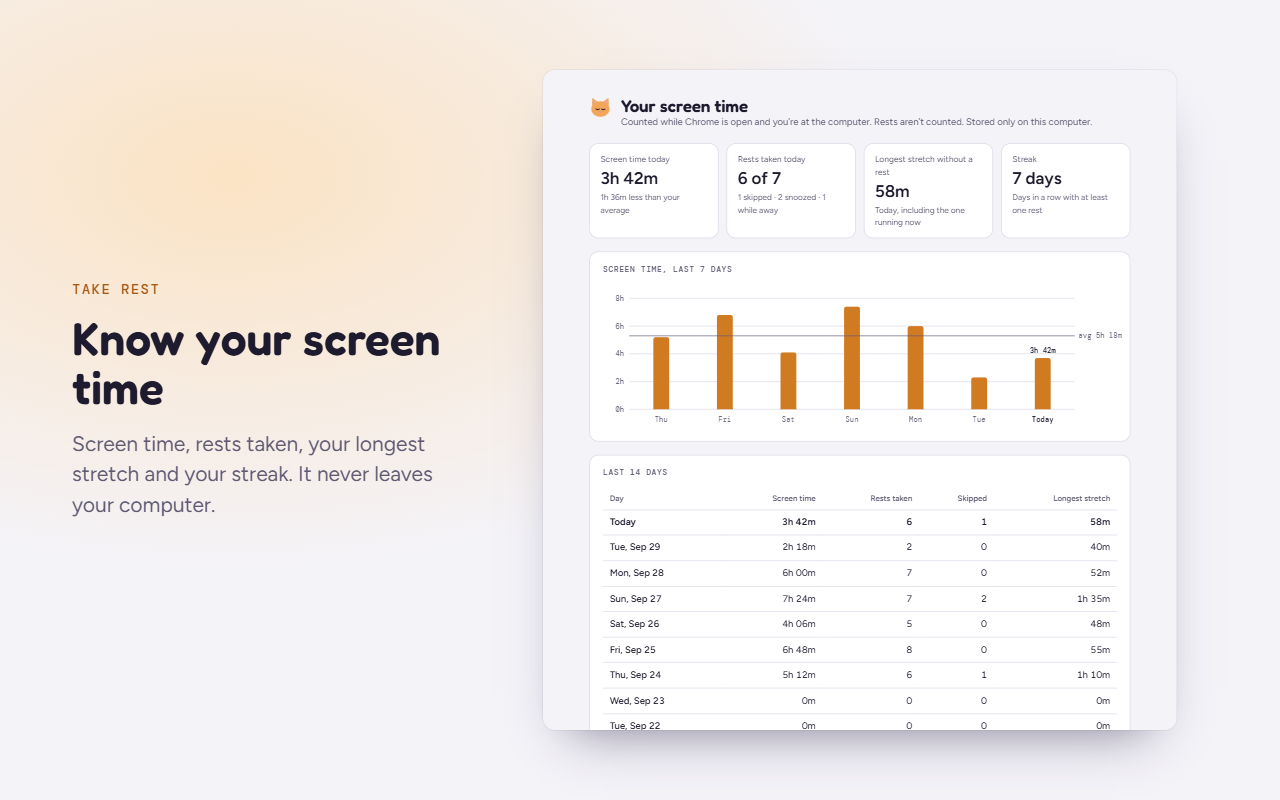
We built Take Rest, a Chrome extension, to fix the “just one more minute” problem. Pick a preset (20-20-20, Pomodoro 25/5, 52/17 or 90/20) or type your own times. When a rest starts, every screen turns black, with a countdown, a rest suggestion and a breathing guide.
You choose how firm it is, from Gentle (skip any time) to Strict (no skipping), with a snooze before each rest and an emergency exit. Your screen-time history stays on your computer. Add Take Rest from the Chrome Web Store and try one rhythm for a week.
Frequently asked questions
Is the Pomodoro technique really effective?
Many people find it helps them start tasks and stay focused, but it does not suit everyone. Try it for a week. If the 25-minute timer keeps interrupting deep work, use a longer rhythm.
Is the 52/17 rule scientifically proven?
No. It comes from one time-tracking company’s data on its own users, and a later study from the same company found different numbers. The useful lesson is to work in focused stretches and take real breaks.
How often should I take a break from the computer?
There is no single right answer. Eye-care groups recommend looking away every 20 minutes, and many people also stand up about once an hour. Pick a rhythm you can keep doing.
What should I do during a screen break?
Stand up, walk a little, look at something far away, drink water and stretch. Checking your phone does not give your eyes or your mind much rest.
One Response